



THE GAP WHERE YOUR MARGIN LIVES
Starlink reselling has one core economic fact: your margin is the gap between the wholesale capacity you commit to and the plans you sell against it. Manage that gap well and every unsold gigabyte is profit. Manage it badly and idle capacity, heavy users, and overage bills eat it.
Most resellers run this on spreadsheets. At 50 kits that is painful. At 500 it is a full-time job. At 5,000 it is where margin goes to die. Starfleet Hub treats wholesale capacity as a commercial asset: pooled, allocated, monitored, and protected in real time.
ONE CONTRACT, MANY CUSTOMERS, ZERO GUESSWORK
Three layers, one source of truth.
Base Pools
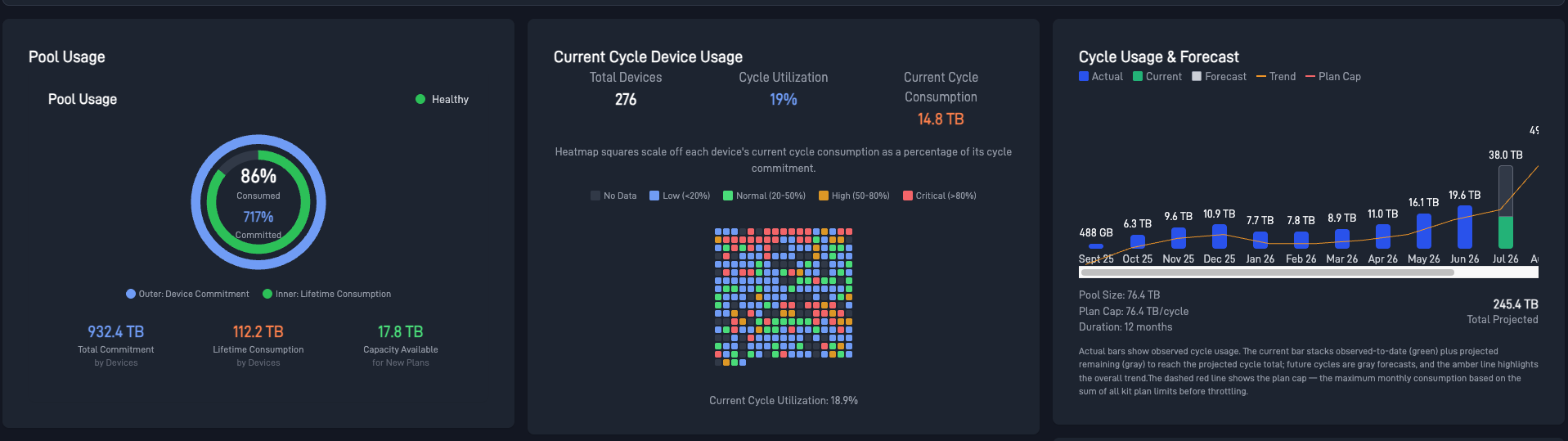
One base pool per wholesale commitment, synced with actual Starlink usage every 15 minutes. The contract, made visible.
Data Pools
Carve each base pool into virtual portions: per partner, per customer, per fleet. Hand a dealer 5 TB of a 50 TB contract without handing them the contract.
Plans
Package pool capacity into what customers buy. Four plan types with their own limits, pricing, and permissions, managed on the platform behind the pools.
SELL 120 TB. PAY FOR 50.
Overselling is how pool margin works. Controls are what make it safe.
Usage never matches allowance: most sites use 300 to 500 GB, a handful spike, and the month lands near 45 TB. The 120 plans you billed cost you one 50 TB commitment. That difference is your margin. In the exception month, per-plan limits and pool throttling engage before the ceiling, and heavy users are offered top-ups at your retail price. The spike becomes revenue instead of an overage bill.
THE CEILING HOLDS ITSELF
Three mechanisms hold the line, and none of them need an operator awake.
Automatic Throttling
Every plan carries a usage limit. When a kit reaches it, the platform throttles the service on its own: the customer stays online, your pool stops draining, and nothing new reaches your wholesale bill. Throttling and unthrottling run on the sync cycle, hands-free.
Self-Service Top-Ups
A throttled customer is a customer ready to buy. Top-ups let them buy more data from their own branded portal at the price you set, with full speed restored the moment payment lands. Automatic top-ups go one step further: customers opt in once, and the platform buys the next block for them when they run out.
FlexiCap Budgets
Uncapped self-service creates its own bill shock. FlexiCap puts a monthly top-up budget on each customer, tracks spending across every top-up source, and pauses self-service at the agreed budget. Predictable for them, collectable for you.
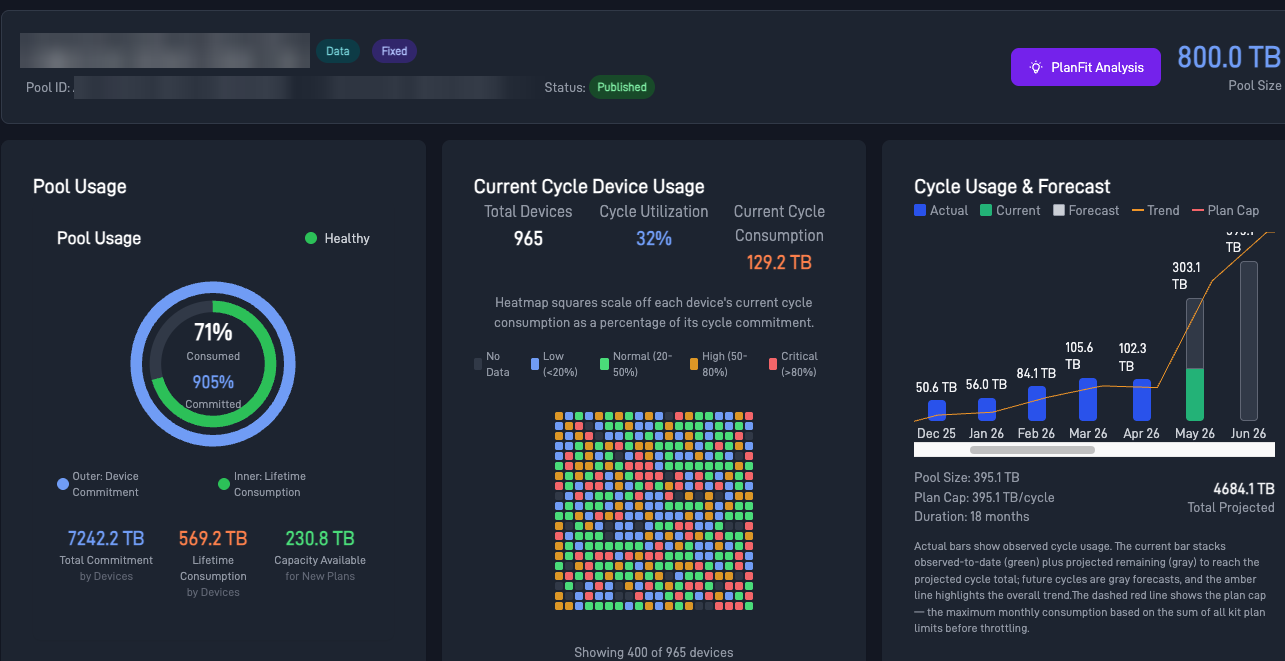
A live pool: 905% committed against a healthy ceiling, per-device usage heatmap, and the cycle forecast tracking consumption against the plan cap.
POOLING, COMPARED
“Pooled data” means different things across the industry. Here is what the label covers on each platform.
| Starfleet Hub | Kognitive Orbit | Armada Atlas | |
|---|---|---|---|
| Pool model | Hierarchical: contract → partner → customer → plan, with controlled oversell | Sub-pools carved from the main Starlink account quota | Pooled data plans on Armada's own reseller service |
| At the limit | Automatic throttling holds the ceiling, then self-service top-ups sell more at your retail price | Documented quota action is a notification at a usage threshold | Positioned as avoiding overage fees on their plans; controls are not published |
| Who operates it | You do: your customers, your prices, white-label portals and invoices | You do, as a cloud subscription in Kognitive's platform | Armada is the reseller; you buy connectivity from them |
| Billing from pool usage | Invoices, payments, and dunning in 30+ currencies, generated from the same usage data | OrbitBills white-label invoicing | Armada enterprise and franchise billing |
| Router estate alongside | Starlink plus MikroTik, Peplink, Teltonika, and TP-Link in one console | Kognitive's own Konnect edge devices | Generic SD-WAN; no named router vendors |
| Delivery | Managed cloud or on-premises appliance | Cloud | Cloud |
Kognitive Orbit and Armada Atlas details reflect each company's published materials as of August 2026. For their platforms, trust their documentation. Kognitive, Orbit, Armada, and Atlas are trademarks of their respective holders. Starfleet Hub is not affiliated with or endorsed by them.
POOLS STOP THE LEAK. PLANFIT FINDS MORE.
Pools protect the margin you have. PlanFit Analytics finds the rest: it compares what each device costs you at wholesale against what you bill for it, flags under-used allowances and oversubscription risk, and ranks the fixes, each with a plain-language explanation of why. One reseller's PlanFit review is where the 23% story below started.
A leading South American reseller restructured pools and plans and lifted margin 23% on the same fleet, without raising a single retail price.
Across four regions, from single-country ISPs to maritime fleets, on one Starlink fleet management platform.
Usage syncs from Starlink every 15 minutes and pool state recalculates continuously.
The names stay private, because our customers' pool structures are their competitive edge. The numbers are the point.

